Wants: pot shot
Duellists and drinkers unite

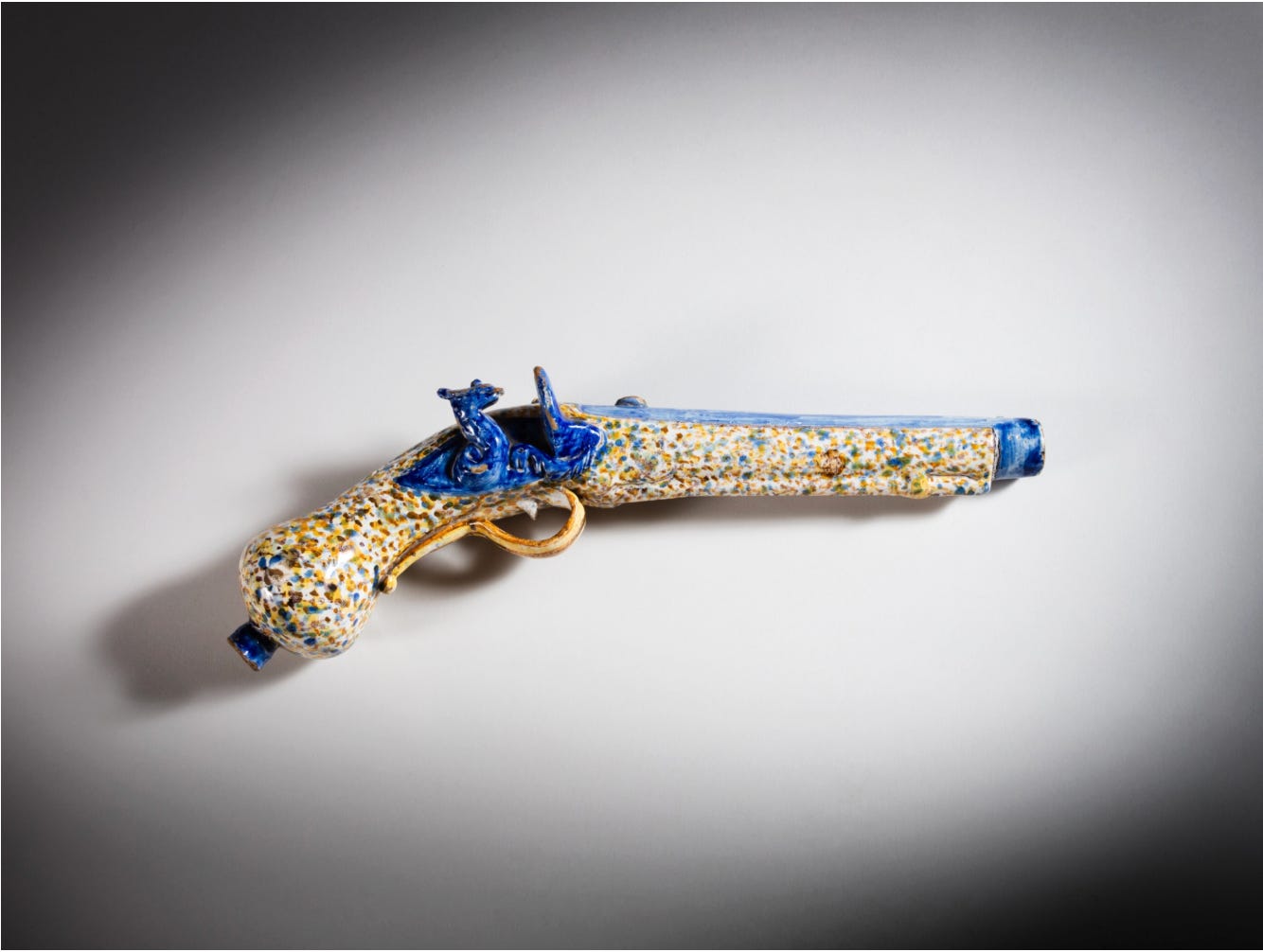
European faience spirit flask in the shape of a pistol, 18th century —possibly Italian work. Sold at Sotheby’s in Paris as part of the Collection of Jean-Marie Rossi Collection Sale, D’un monde l’autre (III), €1,408
One of the things that brought us together as a pair is a shared ‘bullet’ point on our bucket lists: to be challenged to and win a pistol-based duel; an ambition with zero sum consequences if fulfilled together.
This charming flask, which we also feel drawn to, wouldn’t have helped much, since its sole purpose is to knock your compotators dead with a zestier approach to drinking on-the-go. You just have to picture yourself sidling up to a group of boozemates: impossible not to wow them with a piece like this; the dandyish drinking accoutrement par excellence, its tin-oxide glaze finished in a lovely technicolour Paul Smith speckle. Just imagine packing this for a festival! Best to stuff it in among the brioche and pillows to avoid any snappage on the barrel.
The pistol, part of the Jean-Marie Rossi Collection, recently sold at Sotheby’s in Paris for 1,408 euros – we couldn’t resist writing about it for the scenes it conjures: both of silly modes of drinking and silly modes of killing. What is it, we might ask, that makes a flask in the shape of a pistol so jolly? Perhaps it’s a ludic doubleness that we tend to revel in: placing something trivial in the guise of something deadly serious. Might you put the pistol flask in the same category as a gas mask bong? The mind turns, then, to frat-boy theatrics – to the ritual of squirting vodka into someone’s mouth from a water pistol.
Liquor in a pistol, it turns out, has always been fun.
This pistol flaccon might be sold, but we’re still in love with the ritual of the duel – a farcically deadly, acutely playful and yet equally hollow sort of thing. Chapter 7 of Joseph Roth’s 1932, The Radetzky March is a brilliant tribute to the duel’s inherent absurdity. Lieutenant Carl Joseph von Trotta sits drinking with his friend, the regimental doctor, Dr. Demant, who has been trapped by an antisemitic ruse into a duel with the Captain of the Horse. ‘This death makes no sense!’, says the doctor, ‘It’s just as meaningless as my whole life has been’. Defying the duel’s logic, he tells Trotta, ‘Tomorrow, someone will raise a pistol against me, and I will raise a pistol against him. But that will make me a murderer. I am short-sighted. I will not aim. It will be my little revenge.’
In Stanley Kubrick’s adaptation of William Makepeace Thackeray’s Barry Lyndon story, the filmmaker also dwells in the ridiculousness of the duel – and similarly shows his characters defying its absurdity. In the movie’s first duel, Barry believes he has killed a rival, only to learn he’d been loaded with a blank. In the second – which is better, and wholly a product of Kubrick’s own imagination – Barry charitably saves his stepson, Lord Bullingdon, by firing his first shot into the ground. His generous defiance is rewarded when Bullingdon explodes Barry’s leg with the next shot; the bullet fired in a fit of pathetic weeping.
Both Roth and Kubrick investigate the duel via protests against its idiotic, honour-based game of killing. Honour is revealed as a form of theatre, and rather an unconvincing one at that. It’s all (a) play of one sort or another, which from the remote distance of gulping a mouthful of brandy from a pistol like this, is also what the flaccon suggests.
**
This European faience spirit flask in the shape of a pistol, 18th century, sold at Sotheby’s in Paris for 1,408 euros.
This is a fun image. Maybe pistols have always had a strange way of stirring men’s romantic imagination ✨